Scale and Hierarchy in Pocket Sketches
Scale as a compositional language
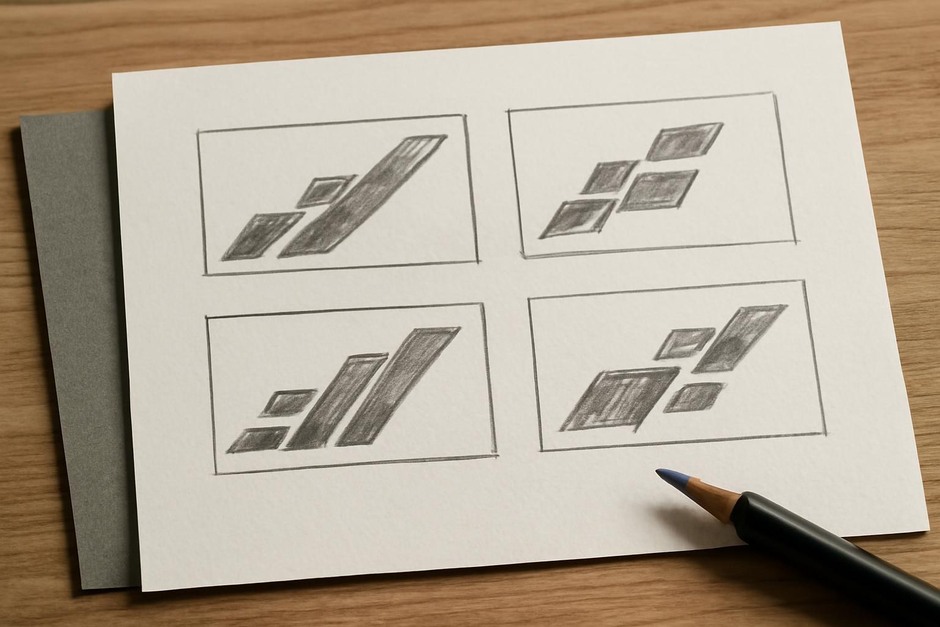
Scale tells the viewer what matters. In a thumbnail, altering the relative size of shapes quickly establishes hierarchy: larger shapes read as important, smaller ones as support. Pocket sketches are ideal for testing scale because they make the hierarchy unmistakable without committing to detail.
Three short drills
Keep the drills compact: three or four thumbnails each, made in under five minutes.
- Single dominant form: draw a single large shape that occupies roughly half the thumbnail. Add two small supporting shapes. Observe whether the large form unequivocally becomes the focal point.
- Graduated series: place a row of four shapes that decrease in size from left to right. Note whether the eye moves toward the smallest or the largest and how that affects perceived narrative direction.
- Interrupted scale: create a sequence of similar shapes where one is unexpectedly larger. This interruption draws attention; test how close or far that anomaly must be to remain noticeable without awkwardness.
Concrete example: a big dark oval on the right with two tiny dots on the left reads as a clear right-side emphasis. Reverse the sizes and see how emphasis flips. The speed of recognition in thumbnails helps you judge how strongly scale cues attention.
Proportion within complex groups
When multiple elements interact, relative proportions determine whether the group reads as a single unit or separate parts. Try arranging three mid-sized shapes near each other, then redraw with one shrunk by half. The smaller shape either recedes or becomes a deliberate subordinate; its proximity to the others will decide whether the group holds as a cluster or fragments.
Using negative scale
Scale does not apply only to positive shapes. Negative spaces can be scaled too. Draw a large, open white area framed by darker marks and compare it to a composition where the white area is divided into several smaller voids. A single large void often reads as calm and dominant; multiple small voids create activity and rhythm.
Practical tips for thumbnails
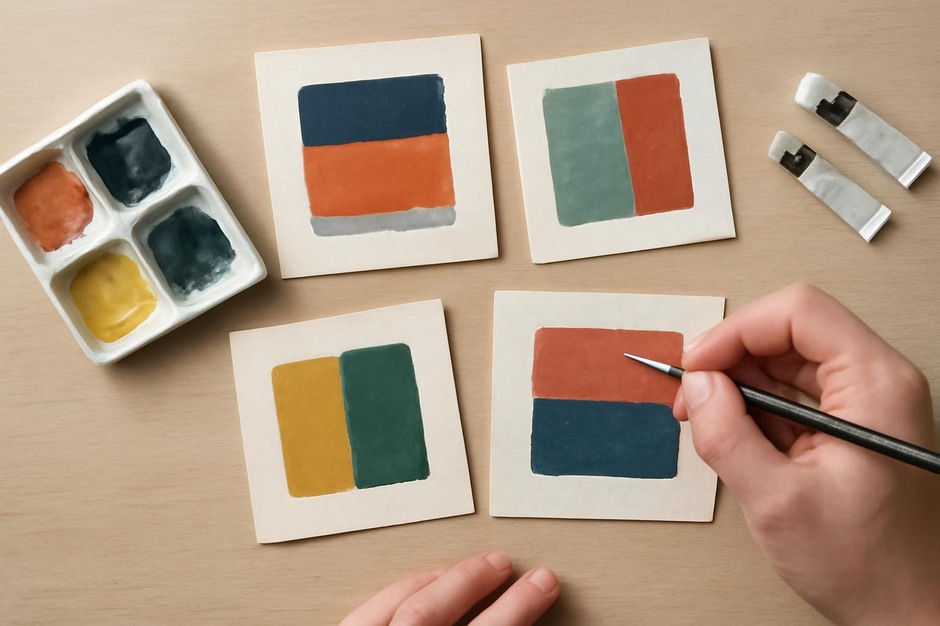
- Start by blocking scale relationships with flat values rather than line detail. This makes the hierarchy easier to judge.
- Use repetition to anchor the scale system: repeating a small shape makes a large shape feel more dominant, and vice versa.
- Test focal strength by squinting at the thumbnail; the dominant shape should still read clearly.
Scale and hierarchy are foundational decisions. Pocket sketches let you make those decisions rapidly and with clarity, so when you move to larger work you already know which shapes must remain prominent and which should stay supportive.